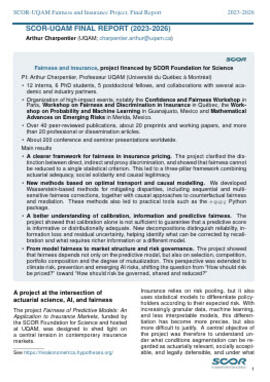
Led by Professor Arthur Charpentier at the Université du Québec à Montréal (UQAM), this three-year project (2023–2026) investigated the challenges of fairness and discrimination in insurance pricing, particularly in the context of increasingly sophisticated predictive models and artificial intelligence. Initially focused on identifying and mitigating algorithmic biases, the research gradually expanded to examine the broader implications of personalized pricing for competition, risk pooling, solidarity, and insurance markets.
Over three years, the project brought together an international team of doctoral students, postdoctoral researchers, and academic collaborators, resulting in over 40 peer-reviewed publications, numerous working papers, a book, and nearly 200 scientific and professional presentations.
The final report highlights five major contributions:
Fairness and Discrimination: Clarified the distinctions between direct, indirect, and proxy discrimination, demonstrating why removing protected characteristics from predictive models does not necessarily prevent discrimination. This research led to a broader framework combining actuarial adequacy, social solidarity, and causal legitimacy.
Mitigating Biases and Counterfactual Fairness: Developed mathematical methods based on optimal transport, Wasserstein distances, and causal models to measure and mitigate disparities, including situations involving multiple sensitive attributes. These advances resulted in theoretical guarantees, practical algorithms, and the open-source Python package EquiPy.
Calibration and Predictive Reliability: Demonstrated that well-calibrated predictions are not necessarily sufficiently informative or fair. New statistical decompositions distinguish calibration errors, information loss, and residual uncertainty, complemented by research on imbalanced datasets, synthetic data, and rare observations.
Competition, Selection, and Risk Pooling: Investigated how competitive dynamics, algorithmic collusion, portfolio selection, and increasingly granular pricing can affect fairness. In particular, the research showed that fairness within an insurer's portfolio does not necessarily translate into fairness across the insurance market, raising broader questions about mutualization and solidarity.
From Predictive Fairness to Risk Governance: Extended the analysis beyond individual models to examine insurance affordability, climate risks, prevention, and the limits of risk segmentation. These contributions emphasize that fair insurance cannot be assessed through predictive accuracy alone, but must also consider how risks are distributed, shared, and managed collectively.
While the project has provided new theoretical foundations and practical tools, important questions remain, particularly concerning how insurance can preserve sustainable and equitable risk sharing in an environment characterized by changing risks, increasingly granular information, and growing competitive pressures.