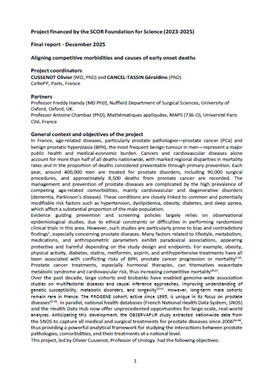
Final report | Aligning competitive morbidities and causes of early onset deaths
The SCOR Foundation research project “Aligning competitive morbidities and causes of early onset deaths” has published its final report.

Running from 2023-2025, this project was led by Olivier Cussenot, Professor of Urology and Director of the Center for Research on Prostatic and Urological Pathologies (CeRePP) in Paris.
Final Report Summary
The project suggests a conceptual and methodological redefinition of prostate cancer (PCa) epidemiology in France, incorporating a new interpretative paradigm. This approach is based on genetic data, competing comorbidities, and advanced causal inference tools. It draws on the joint use of the PROGENE cohort and national medico-administrative databases (SNDS, OBSERVAPUR study), covering several million men monitored between 2006 and 2018.
The first major contribution is based on a national analysis of PSA testing practices and PCa management. More than 37 million tests were recorded in nearly five million men. Screening appears to be both frequent and late, often initiated between the ages of 65 and 75, limiting its impact in terms of specific mortality. Nearly a quarter of men aged 50–70 have locally advanced or metastatic disease at diagnosis. Significant regional disparities are observed. Radical prostatectomy remains the predominant initial treatment, while systemic treatments are increasing, reflecting a growing burden of advanced forms. Active surveillance remains underutilized.
Methodological studies highlight endemic statistical paradoxes associated with the use of PSA as a selection variable. PSA is not a neutral classifier: it is influenced by obesity, treatments, hormonal status, and genetic variants. When exposure alters PSA, it alters the probability of cancer detection without altering its actual prevalence, generating collision bias (Berkson) or the Will Rogers paradox. Even Mendelian randomization can be affected if selection depends on PSA. Corrective strategies are proposed: avoid PSA-dependent stratifications, test the independence of PSA exposure, use multiple controls, and incorporate positive and negative genetic instruments.
A real-world analysis of more than 500,000 patients explores the impact of statins and metformin. The results show a potentially beneficial effect of statins in patients treated with androgen suppression, confirmed by Bayesian causal modeling, while no robust protective effect is observed for metformin.
Finally, a methodological study of low-coverage (4×) genomic sequencing in PROGENE demonstrates good overall concordance with SNP chips, but insufficient sensitivity for certain rare or clinically relevant variants, leading to the current preference for next-generation chips specifically targeting loci of interest.
In conclusion, this research confirms that incidence estimates and their distribution by age group, as published by health authorities, mainly reflect PSA prescribing and interpretation practices rather than the intrinsic biological dynamics of prostate cancer. They also highlight major interpretation biases, linked to the influence of non-causal factors that alter the analytical and predictive performance of PSA – sensitivity, specificity, predictive value – without affecting the actual occurrence or progression of the disease.
These findings call for a redefinition of epidemiological indicators, refocusing on clinically relevant forms – metastatic or lethal – to explicitly take competitive morbidities into account in risk assessment, as well as for the structured integration of pathophysiological and genetic determinants into analytical models.
Such a conceptual and methodological shift would enable the development of personalized screening and management strategies, initiated earlier in at-risk individuals, which are methodologically more robust and more closely aligned with the causal mechanisms underlying the disease.