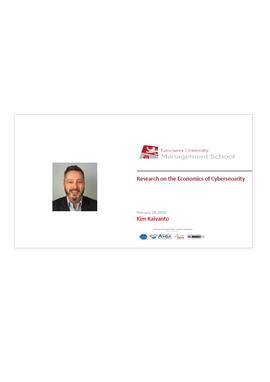
SCOR Foundation Webinar | “Research on the Economics of Cybersecurity”
Held in London on February 19, 2026

The webinar was hosted by Kim Kaivanto, Senior Lecturer in Economics and the Director of the MSc in Money, Banking and Finance at Lancaster University’s Management School (LUMS).
Cybersecurity has been characterized as the interdisciplinary field at the intersection of economics, psychology, and technology. In this webinar, Kim Kaivanto discussed a cross-section of normative and behavioral economics research results relating to cybersecurity, and examined a key question for every Chief Information Security Officer (CISO): “How much should we spend on information security?”
The classic Gordon-Loeb model (2002) provides a framework for answering this question. A more complete approach recognizes that information security investments create externalities and trade-offs between different stakeholder groups. Psychology-inspired behavioral economics models of susceptibility to cyberattack (Embrey & Kaivanto 2023) and of system-level cyber-breach risk (Kaivanto 2014) are also part of this more complete approach. Finally, one can turn to the systemic level and ask questions about the potential for cyberattacks to constitute, or to trigger, systemic risk events in the financial system and other critical national infrastructure (Warren, Prince, Kaivanto 2018).
Together with Mark Roulston, Kim Kaivanto leads the CRUCIAL research Project funded by the SCOR Foundation (2025-2027).

Kim Kaivanto
Kim Kaivanto is a Senior Lecturer in Economics and the Director of the MSc in Money, Banking and Finance at Lancaster University’s Management School (LUMS). Before joining LUMS he held fellowships at the Eitan Berglas School of Economics and Warwick Business School, from where he received his PhD. Kim's research interests are theoretical and descriptive models of decision making and behaviour under risk and uncertainty. He has applied his expertise to problems such as investor sentiment, security behaviour, civil aerospace R&D support schemes, aviation slot allocation and CO₂ emissions, venture capital, and the exploitation of social science research. He has also advised the banking sector on climate risk exposure.