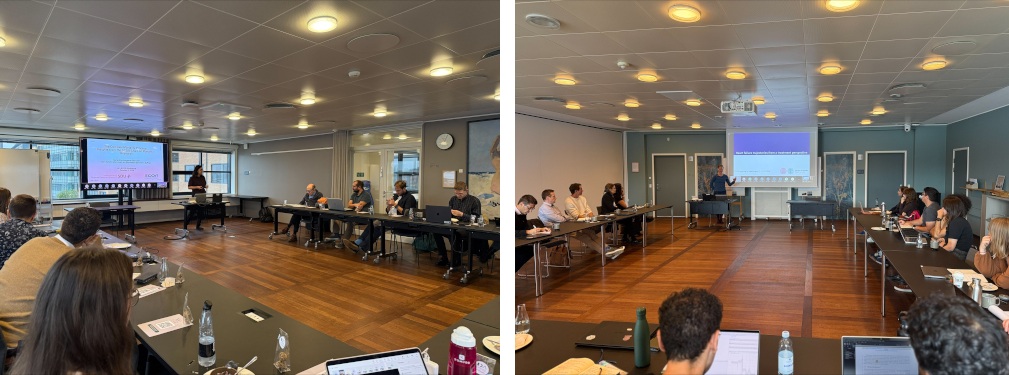
The sixth workshop of the SCOR Chair on Mortality Research brought together researchers from academia and industry to present recent advances in the understanding of mortality, health, multimorbidity, inequalities, and longevity. The discussions highlighted the increasing complexity of mortality processes, the growing importance of multimorbidity, and the need to better understand how social, demographic, and health factors interact throughout the life course. Presentations were organized around four thematic areas: inequalities, causes of death and multimorbidity, health and mortality, and longevity.
1. Inequalities
Research in this session focused on understanding how social, economic, demographic, and geographic factors shape mortality and longevity inequalities.
A first study introduced a novel framework to decompose lifespan inequality across multiple dimensions simultaneously, including sex, race, and educational attainment. The results showed that interactions between social characteristics account for a substantial share of observed inequalities, highlighting the importance of considering intersectionality rather than analyzing each factor independently.
A second presentation examined the concentration of premature mortality risk using nationwide Danish registry data. Although predicting individual deaths remains difficult, mortality risk was shown to be highly concentrated in a relatively small proportion of the population. Economic conditions play an important role in differentiating risk levels, while healthcare utilization and diagnoses become dominant drivers among the highest-risk individuals.
The final contribution reconstructed life expectancy trends across Parisian districts over nearly 140 years. While substantial reductions in within-city longevity inequalities were observed during the first half of the twentieth century, socioeconomic disparities have widened again since the 1970s. Despite Paris being one of the world's longevity leaders, significant differences in life expectancy persist between affluent and disadvantaged districts.
2. Causes of Death and Multimorbidity
This session explored how diseases coexist, interact, and compete in determining mortality outcomes, moving beyond traditional single-cause approaches.
A new competing-risks framework was presented to estimate dependence between causes of death using latent competing failure times linked through a Clayton copula. The approach allows the joint modelling of survival and cause-specific mortality while accounting for interactions between causes. Simulations showed that reductions in one cause of death can lead to a redistribution of deaths across competing causes, illustrating the importance of explicitly modelling disease interactions when assessing future mortality improvements.
Another study investigated mortality among individuals diagnosed with multiple primary cancers. Results revealed substantial heterogeneity according to age at diagnosis, cancer sequence, disease stage, and cancer type, highlighting the importance of disease trajectories for understanding mortality risk.
The final presentation evaluated the relationship between multimorbidity and mortality during the COVID-19 pandemic in Denmark. While individuals with more chronic conditions experienced higher mortality overall, traditional comorbidity gradients were less pronounced for COVID-19 mortality than for non-COVID mortality. Persistent educational and gender disparities nevertheless remained evident throughout the pandemic period.
3. Health and Mortality
The presentations in this session examined how diseases, disease accumulation, and health trajectories influence mortality risks and population health outcomes.
One study focused on improving the detection of undiagnosed diabetes in insurance underwriting. Using mortality-linked health survey data, the authors evaluated alternative screening strategies and demonstrated that targeted medical screening can substantially improve mortality risk classification while remaining economically efficient.
Another contribution emphasized that, in ageing populations, understanding health requires moving beyond the simple presence or absence of disease. Disease accumulation, healthcare utilization, and the burden carried by individuals throughout life have important implications for survival and healthcare systems.
A final presentation discussed the need to integrate information from both living populations and death records to better understand the evolution of chronic diseases and their implications for future mortality trends.
4. Longevity
The longevity session challenged common narratives regarding population ageing and potential limits to human lifespan.
The first study argued that traditional measures of ageing may overstate the burden of population ageing by relying on fixed chronological age thresholds. Adopting prospective measures based on remaining life expectancy suggests a more nuanced picture, where increasing longevity reflects both challenges and opportunities.
A second presentation reassessed claims that progress in human longevity is slowing. Using a Bayesian change-point framework applied to nearly two centuries of mortality data, the study found little evidence that the long-term pace of longevity improvement has declined. Recent flattening of record life expectancy appears to reflect reduced variability rather than a fundamental biological limit.
The final contribution examined measures of familial longevity and the methodological challenges associated with identifying exceptionally long-lived families. The presentation highlighted how selection effects and retrospective study designs can bias conclusions regarding inherited longevity advantages.
Conclusion and Challenges: Understanding the Complex Mortality Process
Mortality is becoming increasingly complex and cannot be adequately understood through traditional single-disease or single-cause frameworks. Research presented throughout the SCOR Chair project demonstrates that individuals increasingly experience multiple chronic conditions, while deaths are typically associated with several interacting causes rather than a single underlying disease. The pathways leading to death are therefore becoming more diverse and heterogeneous.
Several common themes emerged:
• Causes of death form complex and evolving networks of associations rather than independent processes.
• Multimorbidity is becoming a central determinant of mortality, healthcare utilization, and healthy life expectancy.
• Social, educational, geographic, and economic inequalities continue to shape both health trajectories and mortality outcomes.
• Increasing longevity does not necessarily translate into proportional gains in healthy years of life.
• Competing risks and disease interactions complicate the assessment of future mortality improvements and the evaluation of interventions targeting specific diseases.
Looking forward, several key challenges remain for mortality research and actuarial applications:
1. Developing models that jointly capture multimorbidity, multiple causes of death, and competing risks.
2. Better quantifying dependencies and causal pathways between diseases throughout the life course.
3. Integrating health, morbidity, hospitalization, and mortality data into coherent modelling frameworks.
4. Understanding how medical innovations targeting specific diseases translate into overall longevity gains once competing risks are considered.
5. Measuring not only how long people live, but also how healthily they live.
6. Ensuring that mortality projections remain robust in a context of increasing epidemiological complexity and population heterogeneity.
Overall, the workshop reinforced the idea that future improvements in mortality forecasting, public health planning, and insurance risk management will require a more holistic view of the mortality process, recognizing the interplay between diseases, health conditions, social inequalities, and longevity dynamics.
Presentations
Learn more about the Chair on Mortality Research on the SCOR Foundation Project page
